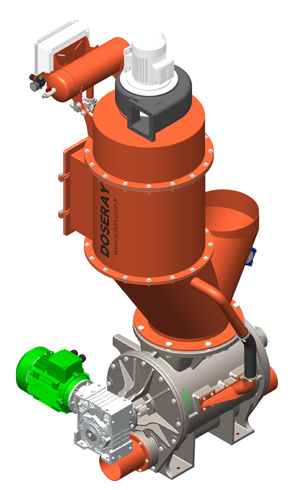
Pneumatic Conveying Lines: Blow-Through Rotary Valves
Our blow-through rotary valves, which feed granular or powder materials into the conveying line, are machined to tight tolerances; air leakage is kept under control and the housing is built to resist wear. DOSERAY selects the right model based on the characteristics of the bulk solid to be conveyed.

The Role of the Rotary Valve in Pneumatic Conveying
By metering product into the air stream, the blow-through rotary valve sits at the heart of every system that moves raw materials by air. Since every plant has its own product and line conditions, DOSERAY engineers each pneumatic conveying solution specifically for the process.
What Does a blow-through valve Do?
In pneumatic conveying systems, the mechanical device that feeds granular or micronized powder solids into the air line and mixes the product with air at a defined ratio is generally called a blow-through valve. Compared with a rotary airlock valve, it is essentially the version with pipe inlet and pipe outlet connections. In the field it is also commonly referred to as a pick-up or blow-through feeder. In Turkish the term comes from the French word écluse (lock) and is most widely used in the flour milling industry.
Which Processes Call for a blow-through valve?
Although the blow-through rotary valve and the rotary airlock share the same basic design, they perform different tasks in the plant; moreover, any airlock can replace a blow-through valve when an eductor is fitted below it. The blow-through valve brings product and air together, whereas the airlock, located below a cyclone or filter, lets gravity pull the product out of the pressurized air. Vane geometry, tolerances and rotor speed are matched to the process and to the conveyed material. If the material allows, the valve can also crush lumps itself or be coupled directly to a crusher. Housings and rotors can be supplied in Ni-Hard, Hardox, AISI-316 or AISI-304 stainless steel, or ST37 carbon steel. The bearing arrangement and sealing elements such as packing glands, mechanical seals or lip seals are likewise selected to suit the process. Available rotors include polyamide-tipped, scraper, adjustable-vane, rounded and bladed designs. In the field this device is also known as a blower rotary valve. If your process requires it, ATEX versions of all series can be produced. ATEX is a certification-based protection class; airlocks in this version are manufactured to directives that demand the highest level of protection.
BLOW-THROUGH ROTARY VALVE OPTIONS BY PROCESS
ROTOR OPTIONS FOR BLOW-THROUGH VALVES – ROTARY VALVES – AIRLOCK FEEDERS
-

- Rotor options — A series (A1–A3): straight open-end vanes; B series (B1–B3): rounded pocket base for sticky products; C series (C1–C3): vanes with bolt-on, adjustable tip strips; D1: closed-end rotor with side discs for metering duty.
Rotary Valve – Airlock
The model that receives material through the top inlet and discharges it through the bottom outlet by gravity and rotor rotation (also called an airlock or airlock feeder; the only thing that sets the blow-through valve apart is that it works in a pneumatic line and is therefore fitted with pipe inlet/outlet connections or an eductor).
 Housing dimensions and flange details: rotary airlock catalogue (PDF)
Blow-Thru Rotary Valve
.
Body diameters we build for this through-blown type: Ø220, Ø250 (long), Ø320 and Ø400 mm
Wear-Resistant
Reinforced Rotary Valves
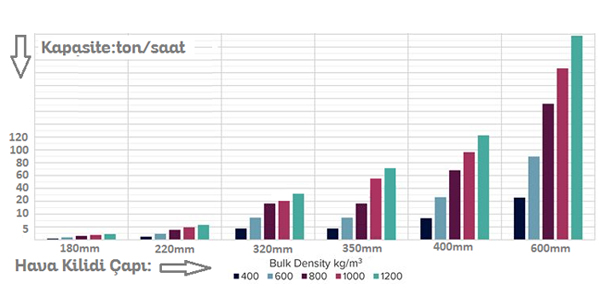
Every rotary valve and airlock we build, in every size, is designed to be fitted with the options your process requires.
When the system runs under pressure, another factor comes into play: the load on the equipment rises and wear accelerates. Abrasive product mixed with air forces its way through the seals, the weakest point. Over time these components fail first and dust begins to escape into the surroundings; then the housing and end covers follow.
Avoiding this scenario, or delaying inevitable wear as long as possible, comes down to the right choice from the outset. In a process handling abrasive products, the equipment will reach the end of its life sooner or later; the real challenge is preventing unplanned downtime. The goal is for the rotary valve to keep doing its job even as wear sets in, and to last until the next planned maintenance shutdown in plants running continuously (24/7).