What Does a Rotary Airlock (Star Feeder) Do?
How a Rotary Airlock Valve Works
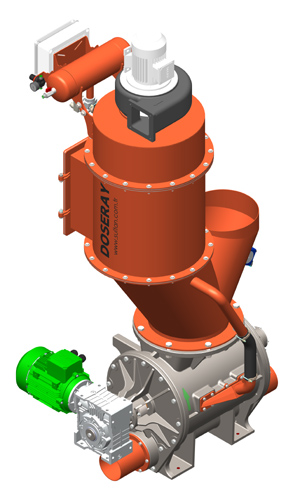
A rotary airlock valve is made up of four main components: a cylindrical housing with its inlet at the top and outlet at the bottom; a vaned rotor that rotates within the housing; a pair of end covers fitted with shaft seals and bearings; and a drive unit, normally a geared motor.
While the rotor rotates, each pocket fills at the inlet, travels round with the rotor and empties at the outlet. Between these two ports, more than one vane is always very close to the housing wall, and together they form a sealing line. It is this seal that lets product pass while a pressure differential is maintained across the valve.
Some air always leaks through the narrow gap separating the vane tips from the housing, and the empty pockets returning to the inlet also carry extra air with them. This leakage increases as the gap widens and the pressure differential rises. In pressure conveying systems, leakage air is usually vented on the inlet side so that it does not obstruct the flow of product into the valve.

Rotor Types in Rotary Airlock Valves
-
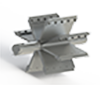
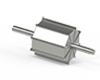
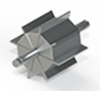
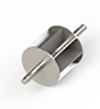
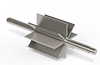
- Options include open-end and closed-end rotors, adjustable or replaceable vane tips, and scraper vanes.
Why DOSERAY for Rotary Valves?
Send us your material data, and our engineers will help you determine the right valve type, size and rotor speed.
 Housing dimensions and flange details: rotary airlock catalogue (PDF)
Blow-Through Rotary Airlock Valve Models
When the valve discharges straight into a pneumatic conveying line, a blow-through housing lets the conveying air pass through the pockets and sweep them clean.
Body diameters we build for this through-blown type: Ø220, Ø250 (long), Ø320 and Ø400 mm
Rotary Valve Applications and Product Range
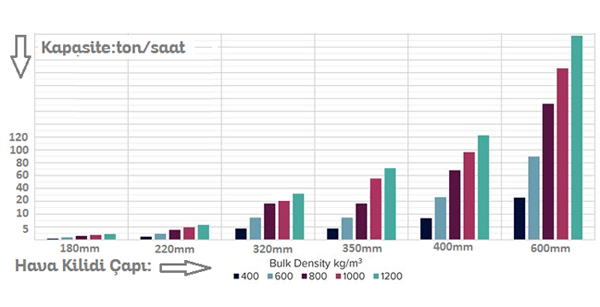
Another widespread use of airlock valves is volumetric feeding, transferring product at a defined rate from hoppers, bins or silos to conveying or process equipment. A rotary valve has no function on its own; it earns its value as one part of a larger bulk or specialty materials handling system. You will find rotary airlock feeders in almost any plant that handles dry, free-flowing pellets, crystals, granules or powders. Examples include flour, sugar, coffee, grain and cereals in food; cement, gypsum, lime and minerals in building materials; as well as plastics, pharmaceuticals, powders and fly ash.
Pneumatic conveying processes differ not only from phase to phase but also within a single phase. Dilute phase (low-pressure) conveying is split into two
groups: vacuum and pressure. Even this distinction leads to small differences in rotary valve and airlock design, which is why we build our rotary airlock valves separately for vacuum lines and pressure lines.