

Rotary Valve Applications
A rotary airlock has two main tasks, but how it is used in the field varies from process to process. The leading applications are listed below:
Rotary Airlocks Below Hoppers
This is the go-to solution when metered discharge is required. It is especially important when feeding product to mechanical conveyors such as belt and screw conveyors; because material flows in a controlled way, sudden surges are prevented from straining downstream equipment.
Rotary Airlocks Below Silos
Rotary airlocks are important auxiliary equipment for discharging storage silos. They can be operated simultaneously with vibrating cones at the silo outlet or with pneumatic lines. In pneumatic conveyors, their form and type vary depending on whether the system is vacuum or pressure.
Rotary Airlocks on Bulk Tanker Loading Bellows
Bulk tanker loading stations and bellows allow material to drop from the hopper into the bulk tanker under its own weight. Because uncontrolled, sudden filling strains the bellows, a rotary airlock should always be placed between the two. This prevents both dust emissions and damage to the bellows.
The Protective Role of the Rotary Airlock in Vacuum Processes
In dryers, filters or special processes affected by the outside atmosphere, the rotary airlock is used to cut off the system's connection with its surroundings. In applications that require isolation and are sensitive to atmospheric conditions, it is the most effective equipment available for this task.
Rotor Options for Rotary Valves, Blow-Through Valves and Airlock Feeders
-
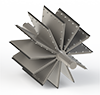
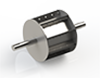
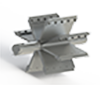
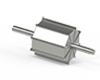
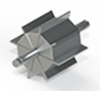
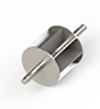
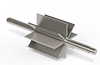

- Rotor options — A series (A1–A3): straight open-end vanes; B series (B1–B3): rounded pocket base for sticky products; C series (C1–C3): vanes with bolt-on, adjustable tip strips; D1: closed-end rotor with side discs for metering duty.
Rotary Airlocks by Housing Material
For abrasive products we recommend choosing a different housing design; with a standard housing, friction can lead to serious damage over time. The same applies to materials that may react chemically. That is why we have expanded our housing options as follows.
- Standard Cast Iron Rotary Airlock
- Cast Steel Rotary Airlock (Ç1050–Ç1060)
- Heat-Treated, Hardened Ç1050 Rotary Airlock
- Ni-Hard 4 Cast Rotary Airlock
- Ceramic-Lined Rotary Airlock
- Teflon / Halar Coated Rotary Airlock
- AISI 304 / 316 Rotary Airlock
Bearing and Mounting Options
The bearing arrangement is at least as decisive as the housing and rotor and varies with process needs. The main bearing types are listed below. On all our models the bearings are positioned outside the housing, making maintenance and part replacement much more practical.
- Standard Outboard Bearings (Vacuum)
- Pneumatic Transfer – Outboard Packing Gland
- High-Temperature Bearings
- Mechanical Seal Bearings
Wear-
Resistant Rotary Valves

Rotary airlocks in every size we manufacture can be fitted with the options you request. The image above shows a model with a ceramic-lined housing interior.
In plants handling abrasive raw materials such as quartz, cement, dolomite, micronized calcite, ash and sand, particularly at mining sites, rotary airlocks must be designed differently from ordinary models. Smooth, correct operation of the process depends on these differences.
These differences fall into three groups:
1- Sealing parts such as lip seals and packing glands
2- A housing prepared for wear with Ni-Hard, special alloy steel or carbide-based coating
3- An alloy steel rotor using carbide-based coating, Hardox or Ni-Hard
Standard model with outboard bearings, blow-through model and internal view of the rotary airlock
There are other details that contribute to service life, but these are the headings to evaluate in general terms. Our rotary airlocks in every size can be built with the options you require.
In pressurized systems, line pressure places extra load on all the equipment and accelerates wear. Abrasive material mixed with air tries to escape, especially through the sealing points; over time it first wears out the seals and spreads dust into the surroundings, then damages the housing and end covers.
 DOSERAY rotary valve product catalogue