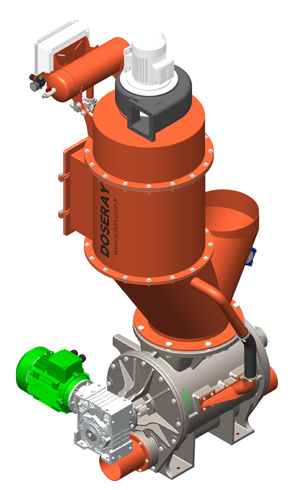
What Is a Rotary Feeder?
A rotary feeder is equipment connected to a cyclone or filter outlet to separate powdered or granular solids from the air.
Rotary Feeder Applications and Selection Criteria
Star feeder, rotary airlock valve and rotary feeder housings can be manufactured from stainless steel (AISI 316 or 304), Hardox, Ni-Hard, or ST52 and ST37 carbon steel. The bearing design and sealing solutions such as mechanical seals and felt seals also vary with the requirements of the application. For lines running at high temperatures or conveying highly abrasive products, rotary airlock valves are built with entirely different specifications.
Rotor options include bladed, radiused (rounded), adjustable-vane, scraper-type and polyamide-tipped models. The only reason for this variety is the nature of the product conveyed and the process itself. Getting the choice right is so critical that a wrong selection can even damage the product. Standard models perform well with flour, cement and many similar materials, but even small deviations in particle size or product properties can stop the valve from doing its job. That is why a rotary feeder must be specified with great care, based on the process.
Rotary Feeders by Application
Rotor Options for Rotary Feeders, Airlock Feeders and Rotary Valves
-

- Rotor options — A series (A1–A3): straight open-end vanes; B series (B1–B3): rounded pocket base for sticky products; C series (C1–C3): vanes with bolt-on, adjustable tip strips; D1: closed-end rotor with side discs for metering duty.
Drop-Through Rotary Airlock Valve
A model that takes material in through the top flange and releases it through the bottom flange (also known as an airlock feeder or rotary feeder).
 Housing dimensions and flange details: rotary airlock catalogue (PDF)
Blow-Through Rotary Valve
A model that receives powdered or granular raw material through the top flange and, by gravity and rotor rotation, passes it directly into the pneumatic line below (also called an airlock or rotary feeder). The only difference from a standard rotary airlock valve is that, because it works on a pneumatic line, it includes pipe inlet/outlet connections or an eductor. The housing design and sealing components are built for pneumatic conveying conditions.
Body diameters we build for this through-blown type: Ø220, Ø250 (long), Ø320 and Ø400 mm
Wear-Resistant
Models


Rotary feeders are used to discharge product collected in pulse jet filters and cyclones, in separators, and to feed product from hoppers into pneumatic lines; in other words, for separating dusty product from air and for dosing.
Pneumatic conveying systems are divided into dense phase and dilute phase, and each phase has its own subgroups. In low-pressure dilute phase conveying, rotary feeders are split into vacuum and pressure applications. This distinction calls for some differences, however small, in the design of the rotary feeder. That is why we build rotary feeders for vacuum or pressure lines specifically to suit your process conditions.