

What Tasks Does a Rotary Airlock Perform?
Rotary airlocks are used in many ways, but all of them fall into two main groups. The first, in pneumatic conveying processes, is metering the conveyed material into the line; the second is separating air from granular or powder product at filter and cyclone outlets. Rotary airlocks can also serve as dosing equipment and for metered discharge at silo outlets.
A rotary airlock performs two distinct functions: in the first it feeds product into the line, where it mixes with the conveying air, while in the second gravity pulls the product out of pressurized air. Vane geometry, tolerances and rotor speed vary with the process type and the product conveyed. With suitable materials it can crush lumps itself and, if needed, run coupled to crushers. Rotary airlocks (airlock feeders) are built from Hardox, Ni-Hard, stainless steel (AISI 304 or 316) and S235JR carbon steel. The bearing type and sealing elements such as packing glands, mechanical seals or lip seals also vary with the process. Rotors are available as polyamide, scraper, adjustable-vane, rounded or bladed types. If your process requires it, all our series are also available in ATEX versions. ATEX is a certification-based protection class, and ATEX-version airlocks are manufactured in line with directives for high protection levels.
Application-Specific Rotary Airlock Models
Rotor Options: Rotary Valves, Blow-Through Valves and Airlock Feeders
-

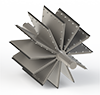
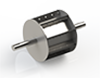
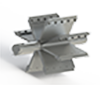
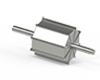
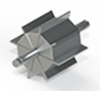
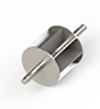
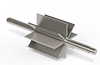
- Rotor options — A series (A1–A3): straight open-end vanes; B series (B1–B3): rounded pocket base for sticky products; C series (C1–C3): vanes with bolt-on, adjustable tip strips; D1: closed-end rotor with side discs for metering duty.
Rotary Airlock Sizes and Usage Information
Product enters at the top and exits at the bottom (also known as an airlock or airlock feeder). Click for more details. Please save the 3D PDFs to your computer first, then open them.
 Housing dimensions and flange details: rotary airlock catalogue (PDF)
Blow-Through Rotary Valve Models
This type receives granular or powder raw material through the top inlet and discharges it through the bottom outlet with the help of gravity and mechanical motion (also known as an airlock feeder or airlock). The only difference from the standard model is that, since it operates in a pneumatic line, it is fitted with pipe inlet/outlet connections or an eductor. The housing design and sealing components are built for pneumatic transfer conditions.
- Drop-Out Box – Venturi – Pick-Up Box (example)
Rotary Airlocks for Abrasive Products

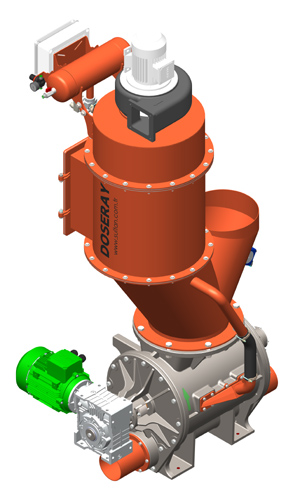
Wear-Resistant Reinforced Rotary Airlocks
In processes handling abrasive raw materials, above all in mining but also quartz, cement, dolomite, micronized calcite, ash (ash rotary valve) and sand, the design of the rotary airlock must differ from standard models. Smooth, correct operation of the process depends on these differences.
These differences fall into three groups:
1- Sealing (packing glands, lip seals, etc.)
2- Wear-resistant housing (Ni-Hard, carbide-type coating, coated or special alloy steel)
3- Alloy steel rotors (Ni-Hard, Hardox or carbide-type coating)
Internal design: blow-through, standard and outboard-bearing rotary airlocks
There are other details that extend service life, but these are the main features to evaluate in general terms. Rotary airlocks in every size we produce can be fitted with the options you request.
In a system running under pressure, the load on the equipment increases and wear accelerates. Abrasive material mixed with air seeks a way out, especially through the sealing points; over time this first destroys the sealing elements and spreads dust into the surroundings, then damages the housing and end covers.
Eductor and Drop-Out Box Applications
In some applications where you want to connect a rotary airlock to a pneumatic transfer line, the inlet/outlet orientation of the pipes can be a problem, or you may not want to dismantle pipework during maintenance. In such plants, a standard rotary airlock is used instead of a blow-through valve, with a venturi-type eductor mounted directly beneath it; there is no need to touch the connected lines during maintenance.
To avoid the wear process described above, or to extend this inevitable process in a controlled way, the right equipment must be chosen. Equipment handling abrasive materials has a naturally limited life; what matters is that production does not stop prematurely. Even when damaged, the airlock must keep running and, in plants operating continuously (24/7), hold out until the first planned maintenance break.


