

What Does a Star Feeder (Rotary Airlock) Do?
"Star feeder" is just one of several names that vary by industry; the equipment it describes is the same as a rotary airlock. In other words, both terms refer to the same device. It is used in many ways, but its tasks can be summarized in two main groups: the first is feeding the product to be conveyed into pneumatic conveying lines, the second is separating granular or powder material from air at filter and cyclone outlets. In addition, it can serve as a dosing element or as a device that discharges product at a metered rate from a silo outlet.
Key Considerations When Using Star Feeders, Airlock Feeders and Rotary Airlocks
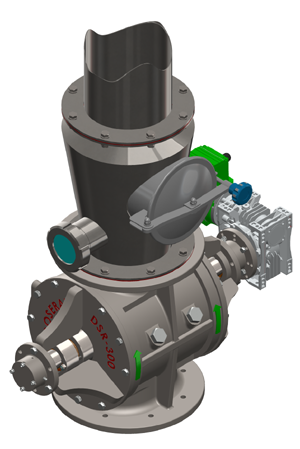

The device has two functions: in one application it brings product and air together, in the other it uses gravity to separate material from pressurized air. Vane geometry, tolerances and rotor speed are set by the process and by the material being handled. With suitable materials it can crush lumps itself and, if necessary, run coupled directly to a crusher.
Housings for star feeders (airlock feeders, rotary airlocks) are made from stainless steel, AISI 316 or 304, or from ST37 carbon steel. The bearing arrangement and sealing parts such as mechanical seals and lip seals can also vary with the application.
Available rotors include polyamide, scraper, adjustable-vane, rounded and bladed designs. This variety allows the rotary airlock to be adapted to almost any process.
The existence of so many alternatives stems entirely from the character of the product conveyed and the nature of the process. The subject is so important that a poor choice can actually harm the conveyed material. Simple models on the market may cope with many products, flour and cement among them; but when the particle size or the structure of the material changes even slightly, the same valves can no longer do their job.
For example, a rotary airlock working on a cement line cannot be used for sunflower seeds. The main reason is the oily nature of sunflower seeds: seeds caught between the steel vanes are damaged, and because of the released oil the vane cells gradually become coated with seed fragments. After a while half of each cell stays full and conveying capacity drops by 50%.
On high-pressure lines, a wrongly chosen rotary airlock can damage the bearings; an unsuitable vane type can also grind the product or even make it wind around the rotor. Our experience has shown us that every process has its own operating regime. The right solution should be defined by a specification prepared specifically for each capacity and each process.
Where Star Feeders, Airlock Feeders and Rotary Airlocks Are Used
They are used to discharge product from jet filter outlets, in separators, to feed material from hoppers or silos into pneumatic lines, to separate dusty product from air, for metered feeding from big bag discharge stations into pneumatic lines, and in gravimetric dosing.
Star Feeder (Rotary Valve, Blow-Through Valve, Airlock Feeder) Rotor Types
-

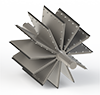
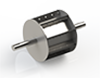
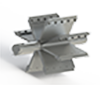
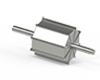
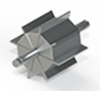
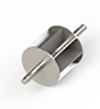
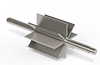
- Rotor options — A series (A1–A3): straight open-end vanes; B series (B1–B3): rounded pocket base for sticky products; C series (C1–C3): vanes with bolt-on, adjustable tip strips; D1: closed-end rotor with side discs for metering duty.
Star Feeder Sizes and Use
The model that receives material through the top flange and releases it through the bottom flange (also known as an airlock or airlock feeder). Click for details. We recommend saving the 3D PDF files to your computer first and then opening them.
 Housing dimensions and flange details: rotary airlock catalogue (PDF)
Blow-Through Rotary Valves
- Drop-Out Box – Venturi – Pick-Up Box (example)
Wear-
Resistant Star Feeders


Eductor and Drop-Out Box Options
When you want to position a rotary airlock within a pneumatic line, the inlet/outlet orientation of the pipes may get in the way, or you may not want to dismantle pipework during servicing. In such cases, a standard rotary airlock is chosen instead of a blow-through valve and a venturi-type eductor is added to its outlet. With this arrangement, the pipes connected to the line stay in place while the valve is being serviced.

We can fit our rotary airlocks in every size with the options you request.
In pressurized systems, line pressure places extra load on all the equipment and accelerates wear. Abrasive material mixed with air tries to escape, especially through seals and packing; over time the sealing parts fail first and dust spreads into the surroundings, then the housing and end covers are damaged.
Preventing this wear or postponing it in a controlled way depends on the right selection. In plants processing abrasive material, equipment life has its limits; what matters is not causing an unexpected shutdown. Even when damaged, the rotary airlock must be able to keep doing its job and carry the line until the first scheduled maintenance in continuous (24/7) production.
 LEARN MORE