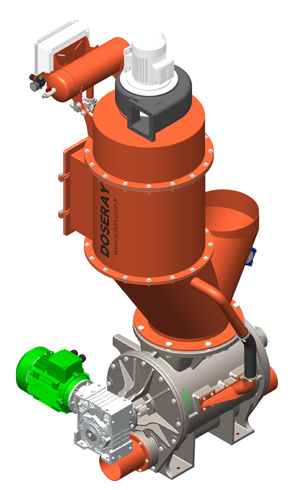
What Is a Rotary Feeder Used For?
A rotary feeder is the device used below a filter or cyclone to separate powdered or granular product from the air.
What Is a Rotary Feeder?
Equipment installed below cyclones and filters to separate air from powdered or granular material is called a rotary feeder.
Rotary feeders and star feeders can be manufactured from Hardox, Ni-Hard, stainless steel (AISI 316/304) or carbon steel (ST52 and ST37). The bearing arrangement and sealing solutions such as mechanical seals and felt seals are selected to suit the process. Rotary feeders for hot products or highly abrasive materials are built specifically for those conditions.

Rotor options include polyamide-tipped, scraper-type, bladed, adjustable-vane and radiused designs. The reason for so many options is the type of material being conveyed and the process itself. The choice is so critical that a wrong decision can damage the product. With flour, cement and many similar materials, ordinary off-the-shelf solutions may do the job, but even small changes in particle size or material properties can render these units ineffective. That is why the rotary feeder must be carefully selected to match the process.
Application-Specific Rotary Airlock Valves
Rotor Options for Rotary Feeders, Rotary Valves and Airlock Feeders
-

- Rotor options — A series (A1–A3): straight open-end vanes; B series (B1–B3): rounded pocket base for sticky products; C series (C1–C3): vanes with bolt-on, adjustable tip strips; D1: closed-end rotor with side discs for metering duty.
Drop-Through Rotary Feeder
Product is taken in at the top inlet and discharged at the bottom outlet (also known as an airlock feeder or rotary feeder).
 Housing dimensions and flange details: rotary airlock catalogue (PDF)
Blow-Through Rotary Valve
Granular or powdered raw material enters at the top inlet and leaves at the bottom outlet by gravity and rotor rotation (also referred to as an airlock or rotary feeder; the only difference is that, because it operates on pneumatic lines, it has pipe inlet/outlet connections or an eductor).
Body diameters we build for this through-blown type: Ø220, Ø250 (long), Ø320 and Ø400 mm
Suitable for Vacuum
and Pressure Lines
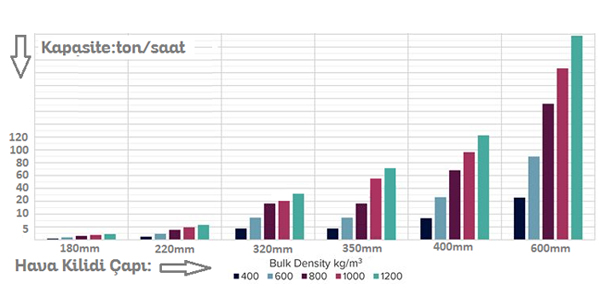

Rotary feeders are mostly used to discharge material collected in pulse jet filters and cyclones, in separators, and to feed product from hoppers into pneumatic lines; in short, their job is to separate air from dusty material and provide metered dosing.
Pneumatic conveying is divided not only by phase; each phase is further split into subgroups. For dilute phase (low-pressure) conveying, rotary feeders come in two classes: vacuum line and pressure line types. Even though the difference is small, it affects how the unit is designed. That is why we manufacture rotary feeders for vacuum and pressure lines to suit your process.