
Rotary Airlock Valve Manufacturing from Design to Testing
DOSERAY rotary airlock valves are manufactured in our workshop in Çiftlikköy, Yalova. The dimensions of every rotary airlock valve are determined by the product it will handle and the process it will run in; in other words, it is not an off-the-shelf item but equipment built to meet your needs.
Production Steps
Housings and end covers are made from carbon steel or stainless steel, and the rotor vanes are welded to the shaft. To achieve the required clearance, the housing bore and the rotor's outer diameter are machined. During assembly, the bearings, seals and drive components are also adjusted.
Testing and Shipment
Every assembled rotary airlock valve is checked to ensure that the rotor turns without rubbing the housing, the motor current stays at normal levels and the seals do not leak; only then is it delivered. For special applications handling ash or granules, rotor and housing materials are selected to suit the product. For a quotation, simply write to us at info@doseray.com.
In Which Systems Are Rotary Airlock Valves Used?
A rotary airlock valve is a mechanical device with a vaned rotor, mostly used to separate powdered or granular product from the air in pneumatic conveying systems that run under positive pressure or vacuum. It is most commonly installed below filters and cyclones. Capacity is determined by the valve's diameter and speed, while efficiency is influenced mainly by vane clearances. The valve can also be operated as a dosing element or as proportional discharge equipment below silos.
As the name suggests, a rotary airlock valve is a device that locks in, or traps, the air; here, trapping means preventing air from passing from one side to the other.
In vacuum or pressure systems, solid powders and granules must either be separated from the air or mixed into it for pneumatic conveying. Processes designed this way are the main field of application for rotary airlock valves.
In short, rotary airlock valves are equipment that separates or combines product and air in vacuum and pressure systems. Besides their use below cyclones and filters, they also serve as dosing rotors and as intermediate equipment in a variety of processes.
Rotary Valve and Rotary Airlock Valve Types
Although it may look like standard equipment at first glance, a rotary airlock valve is shaped by the process it will serve and the character of the raw material passing through it.
The decisive properties include temperature, capacity, bulk density, abrasiveness, particle size, operating pressure and chemical composition. The type and form of the rotary airlock valve are determined mainly by these parameters.
For rotary feeder housings and rotors, you can choose stainless steel (AISI 316 or 304), Ni-Hard, Hardox or ST37 carbon steel. The bearing arrangement and sealing elements such as packing glands, mechanical seals and felt seals vary with the needs of the process. Rotor options include polyamide-tipped, scraper-type, adjustable-vane, radiused and bladed designs.
Rotary Airlock Valves for Different Processes
-

- Rotor options — A series (A1–A3): straight open-end vanes; B series (B1–B3): rounded pocket base for sticky products; C series (C1–C3): vanes with bolt-on, adjustable tip strips; D1: closed-end rotor with side discs for metering duty.
Rotary Airlock Valve Dimensions
Model that takes product in from above and delivers it below (also known as an airlock feeder or rotary feeder).
 Housing dimensions and flange details: rotary airlock catalogue (PDF)
Blow-Through Rotary Valve
Powdered or granular raw material is taken in at the top of the unit and discharged at the bottom by gravity and rotor movement (also called an airlock or rotary feeder; the only difference is that, because it is used on a pneumatic line, it includes pipe inlet/outlet connections or an eductor).
Body diameters we build for this through-blown type: Ø220, Ø250 (long), Ø320 and Ø400 mm
Why DOSERAY for Rotary Airlock Valves?
A rotary airlock valve may look like a simple machine from the outside, but designing and building one takes know-how and experience. Drawing on thousands of units in service across a wide range of processes, our goal is to supply industrial plants with products that offer excellent sealing, low maintenance and maximum durability.
Rotary Airlock Valve Capacities
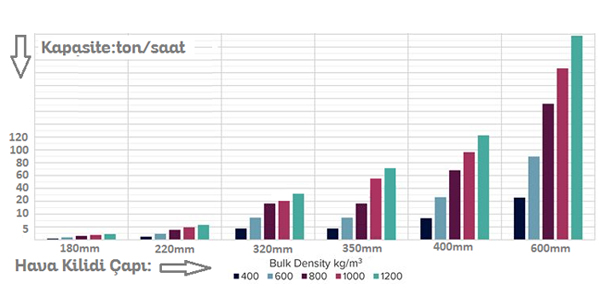


The large number of options in rotary airlock valves and rotary feeders stems from the type of material conveyed and the nature of the process. This matters so much that a wrong choice can even spoil the product. With materials considered easy, such as flour, a basic off-the-shelf unit might be adequate at first. However, as the particle size of the pneumatically conveyed product changes and its behavior under temperature and pressure varies, standard units fall short. We evaluate the technical data you provide using our engineering calculations and build rotary airlock valves matched to target capacity, back pressure, operating pressure and temperature, and material size and type (abrasiveness, friability, fibrousness, etc.). These valves share the same basic design, while their service life varies with the process, helping your plant run continuously with minimal downtime.
LEARN MORE