

What is a rotary valve used for?
Rotary valves, known in the field as rotary airlocks, serve two main purposes: in pneumatic conveying systems they meter material into the line, and below filters and cyclones they discharge granules or powder separated from the air.
In the first use, the valve brings product together with the conveying air, while in the second it relies on gravity to release product from the pressurized air stream. Vane profile, clearances and rotor speed are chosen to suit both the process and the material in question. With suitable materials, the valve can also perform a crushing function or be connected to a crusher. Construction materials are stainless steel (AISI 316 or 304) and ST37 carbon steel. The bearing arrangement and sealing elements (packing gland, mechanical seal, lip seal) are also specified separately for each process. On the rotor side, you can choose from polyamide, scraper, adjustable-vane, rounded-pocket or bladed designs.
Rotor Options for Rotary Airlock Valves
-

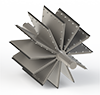
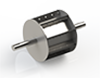
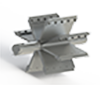
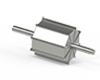
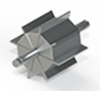
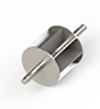
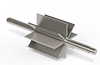
- Polyamide-tipped, scraper, adjustable-vane, rounded-pocket and bladed rotor types are available for rotary valves, rotary airlocks and star feeders.
Choosing the Right Rotary Airlock
Why are there so many rotary valve variants? Because the right design is dictated by the material itself and the process; the wrong choice can even degrade the product being conveyed. With free-flowing materials such as flour, a simple standard valve may seem adequate at first. But once the particle size varies and the material starts behaving differently at different temperatures and pressures, that valve quickly reaches its limits.
Our engineers size every valve by calculation based on the customer's data: back pressure, operating pressure and temperature, particle size and material characteristics (abrasive, friable, fibrous, etc.).
Here is an example from the field. A cement valve has to be designed with wear resistance in mind, whereas a valve handling sunflower seeds must treat the product gently. A single design cannot do both jobs: sunflower seeds contain oil; when steel vanes crush the seeds, the released oil and fragments gradually fill the pockets. In time, oily residue fills each pocket halfway and conveying capacity drops by 50%. Similarly, high-pressure operation can damage the bearings, and an unsuitable vane profile can grind the material or make it wind around the rotor. Our experience has shown that every process runs under its own regime and every capacity calls for its own answer. This principle guides all of our rotary valve production.
 Housing dimensions and flange details: rotary airlock catalogue (PDF)
Multi-purpose rotary valve
Developed for heavy-duty conditions, this rotary airlock is extremely versatile. It suits dilute-phase pneumatic conveying under vacuum, under pressure, or in a combined vacuum and pressure mode, with a differential pressure of up to 15 PSI. Versions are also available for abrasive duties and for temperatures as high as 450 °F. For easy replacement, the flange bolt pattern can be matched to many competitors'
valves. On models MD40 to MD260, the housing is made of class 40 grey cast iron with a hardness of 217 Brinell, providing greater strength and wear resistance.
Body diameters we build for this through-blown type: Ø220, Ø250 (long), Ø320 and Ø400 mm
PRODUCTS


A range of capacity options
- Simple, straightforward design
- Easy maintenance
- Various rotor vane types
- Robust construction
- Wide rotary valve range