

Using Rotary Airlocks with Abrasive Materials
Cement, sand, calcite, crushed glass and mineral powders wear out a standard carbon steel rotary airlock very quickly. As the housing and rotor wear, the gap between them widens, air leakage rises and capacity falls.
Housing Material and Coating Options
These models have housings made from Ni-Hard castings or Hardox plate; if needed, a hard coating is applied to the internal surface for added resistance. Because the rotor vanes are fitted with removable wear tips, only these tips need replacing when they wear, not the entire rotor.
Operating Conditions
Wear increases as the peripheral speed of the vane tips rises. With abrasive material, running a large-bodied airlock slowly therefore gives a longer life than running a small one fast. Since leakage air also accelerates wear where the pressure differential is high, we recommend adding a vent port. For details, see our heavy-duty rotary airlock page.
Rotary Airlock Basics
A rotary airlock is a mechanical device with a vaned rotor, mostly used to separate powder or granular product from air in pneumatic conveying systems working under pressure or vacuum. Filter and cyclone outlets are the most common mounting points. Capacity is mainly determined by housing diameter and rotor speed, while vane tolerances are the most critical factor in efficiency. Beyond this, a rotary airlock may also serve as a dosing element or as a metered discharger at silo outlets.
To sum up the functions of a rotary airlock in one sentence: it introduces product into air, and it uses gravity to separate product from pressurized air. Vane geometry, tolerances and rotor speed are tailored to each process and to the product being handled. With suitable products, the valve can crush lumps itself or even run coupled to crushers. Rotary valve / airlock housings are available in Ni-Hard, Hardox, AISI-316 or AISI-304 stainless steel, and ST37 carbon steel. On rotary valves (airlocks), the bearing arrangement and sealing parts such as packing glands, mechanical seals and lip seals are also selected to suit the process. Internal rotors come in polyamide, scraper, adjustable-vane, rounded and bladed versions...
The images below give you a picture of how the rotors are built. Valves that look identical from the outside differ in their internal design, which brings a large number of options to rotary airlock selection. Process data must therefore always be taken into account when choosing. The one point never to forget is that no single airlock fits every process.
APPLICATION-SPECIFIC ROTARY AIRLOCKS
ROTARY VALVE - BLOW-THROUGH VALVE - AIRLOCK FEEDER - ROTARY AIRLOCK ROTOR TYPES
-

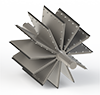
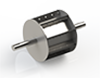
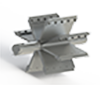
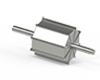
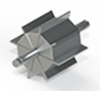
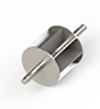
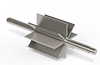
- Rotor options — A series (A1–A3): straight open-end vanes; B series (B1–B3): rounded pocket base for sticky products; C series (C1–C3): vanes with bolt-on, adjustable tip strips; D1: closed-end rotor with side discs for metering duty.
-
Using Eductors and Drop-Out Boxes with Rotary Airlocks
When a rotary airlock is part of a pneumatic line, the directions in which the pipes connect can make servicing difficult; plants are not keen on dismantling pipework for maintenance. The solution is to use a standard rotary airlock instead of a blow-through valve and connect an eductor to its outlet that draws product into the line by the venturi effect. The line connections stay in place when the valve is taken out for service, giving the operation flexibility. -


 Housing dimensions and flange details: rotary airlock catalogue (PDF)
Standard Rotary Valve Series
Body diameters we build for this through-blown type: Ø220, Ø250 (long), Ø320 and Ø400 mm
Wear-Resistant Rotary Airlocks

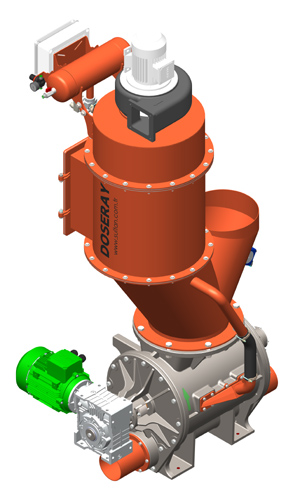
Rotary Airlocks and Blow-Through Valves for Abrasive Products
Rotary airlocks for plants processing abrasive raw materials, above all in mining but also ash, sand, quartz, cement, dolomite and micronized calcite, must be built differently from standard models. Continuous, fault-free operation of the process depends on these differences.
These differences can be grouped under three headings.
1-Sealing: lip seals, packing glands and similar elements
2-Housing: reinforced against wear with special alloy steel, Ni-Hard or carbide-type coatings
3-Rotor: Hardox, Ni-Hard or alloy steel with carbide-type coating
blow-thru type, non-standard bearing type and the internal design of the rotary airlock
There are other features that extend rotary valve life, but these are the headings that can be assessed in general terms. Rotary airlocks in every size we manufacture are designed so that they can be built with the options you request.
If the system is pressurized, the picture becomes even tougher; line pressure puts all the equipment under extra load and accelerates wear. Abrasive raw material mixed with air tries to escape, especially through the sealing points; over time this first wears out the seals and spreads dust into the surroundings, then damages the housing and end covers.

Preventing the wear process described above and extending this natural process in a controlled way is only possible with the right selection. In processes handling abrasive material, equipment life is inevitably limited. What matters is not allowing unexpected shutdowns. The rotary airlock must also keep running even when damaged and carry the line until the next planned shutdown in plants operating 24/7.
LEARN MORE